This page lists nutrition figures from Takis packaging alongside published NHS guidance. It isn't health or medical advice.
Dietary
Are Takis Bad for You? What's in a Bag
In short
This page sets out what's in a bag of Takis, using the nutrition figures from UK packs and the daily limits published by the NHS. Whether Takis suit your own diet depends on your health and everything else you eat, and that's a conversation for a GP or dietitian.
What's in a bag of Takis
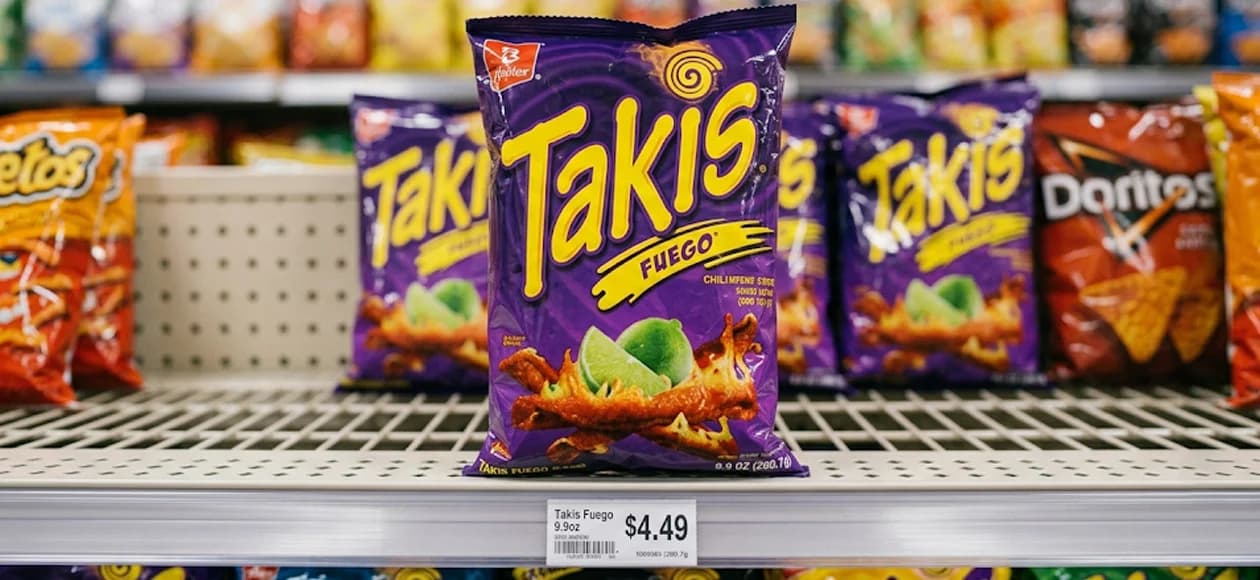
These are the figures for Takis Fuego, the flavour you're most likely to find in UK shops. Every flavour page has its own panel.
| Nutrient | Per 100g | Per 30g |
|---|---|---|
| Energy | 2130kJ / 511kcal | 639kJ / 153kcal |
| Fat | 29g | 8.8g |
| of which saturates | 2.7g | 0.8g |
| Carbohydrate | 53g | 16g |
| of which sugars | 1.7g | 0.5g |
| Fibre | 6.2g | 1.8g |
| Protein | 5.6g | 1.7g |
| Salt | 0.63g | 0.19g |
Sources – Fuego: Iceland's Takis Fuego 180g product page. Recipes change, so the label on your own pack is the final word.
To work out a whole bag, multiply the per-100g figures by the weight printed on the front of your pack.
Salt and saturated fat by flavour
Salt varies a lot across the range, from 0.18g per 30g in Intense Nacho up to 1.04g in Xtreme Lime. Heat level doesn't tell you much here: Xtreme Lime has no chilli heat and the most salt of any flavour. Each flavour page lists its own figures.
Sources – Intense Nacho: Ocado's Takis Intense Nacho product page; Xtreme Lime: NutriScan's Takis Xtreme Lime nutrition breakdown (per-30g figures calculated by us from its per-100g values). Recipes change, so the label on your own pack is the final word.
How the figures compare with NHS daily limits
The NHS says adults should have no more than 6g of salt a day (NHS: Salt in your diet). One 30g serving of Fuego contains 0.19g, which is 3% of that.
For saturated fat, the NHS says men should have no more than 30g a day and women no more than 20g (NHS: Eat less saturated fat). One 30g serving of Fuego contains 0.8g, which is 3% of the limit for men and 4% of the limit for women.
The NHS sets lower salt limits for children. Our Takis for kids guide lists them by age.
Ingredients and colourings
Each flavour page lists the ingredients from UK packaging. On colourings, Iceland's listing for UK Fuego gives paprika extract as the colour, and UK Takis use different colourings from the US versions – our UK vs US Takis guide covers the differences.
Where to find health advice
We don't cover questions about Takis and cancer, stomach pain or other health conditions. These are good places to start:
- NHS: Eat well – general guidance on a balanced diet
- NHS: Indigestion – common causes of stomach discomfort and when to see a GP
- Cancer Research UK: Diet and cancer
For anything about your own health, speak to a GP or pharmacist.
For other dietary questions about Takis, see our guides on whether Takis are halal, whether Takis are vegan or vegetarian, and whether Takis are gluten free. If you'd rather buy a bag you can check in person, use the Takis Near Me search tool to find your nearest stockist.
Frequently asked questions
We don't answer that with a yes or no, because it depends on your health and the rest of your diet, and we aren't health professionals. The figures are these: a 30g serving of Takis Fuego contains 0.19g of salt and 0.8g of saturated fat. The NHS says adults should have no more than 6g of salt and 20–30g of saturated fat a day. For advice about your own diet, speak to a GP or dietitian.
It depends on the flavour. A 30g serving contains between 0.18g and 1.04g of salt across the range. Takis Fuego contains 0.19g per 30g, which is 3% of the NHS adult daily maximum of 6g.
Intense Nacho has the least salt per serving, at 0.18g per 30g. Xtreme Lime has the most, at 1.04g.
A 30g serving of Takis Fuego contains 0.8g of saturated fat. The NHS says men should have no more than 30g a day and women no more than 20g, so one serving is 3% and 4% of those limits respectively.
We don't cover questions about Takis and cancer, stomach pain or other health conditions. The NHS website is the best starting point, and a GP or pharmacist can advise on your own health.
ℹ Links marked “Ad” are Amazon affiliate links. As an Amazon Associate we earn from qualifying purchases, at no extra cost to you. See our Affiliate Disclosure for full details.